Showing posts with label l1dancefest. Show all posts

Thursday, January 10, 2013

Ligia Manuela Lewis / Sensation 1. – Conviction Series


Sensation 1. was performed in MU Theatre on the last day of L1dancefest 2012, September 23rd. In my opinion, it was one of the most meaningful performances in the programme of the event series. After the performance, an expression was born in my mind, which I think can express what the piece was about: it was like a kinetic painting of a ‘vocal desert’.
A woman standing on the stage, naked, locked within herself, tense with repressed musical notes, performing the tragedy of muteness. All of her muscle fibres and joints shivering with the voice that was broken into her body. Even though she is naked and exposed, she is standing firmly on her feet, her limbs, her stomach, her chest and her fists are tense. 


Singing with her face and her body, the artist is performing a physical aria in a series of poses, the transition between which is slow, delicate, fluid, liquid. One time she is standing in a pose of surrender; later, broken by the weight of voicelessness, she changes to a sort of Terminator-pose. Standing rooted to the spot, her facial expressions reach up into an ethereal highness of invisible musicality; it is like she is torn between our world and another world from which only she can hear the music.


This brings me to the main question that bothered me throughout the piece: is she really the one who is mute? Or is the audience deaf? Is it her who cannot convey the voice developing in her throat, or are we incapable of receiving her message, of tuning in to her frequency?
The tension is intensifying throughout the piece, but there is still not a single note that leaves the lips of the performer, even saliva comes sooner than sound. 


Then, at the end, we can hear music playing, and, at the same time, the space is darkening. The piece reaches its climax, we can hear the well-known chorus of “I will always love you” by Whitney Houston. However, by this time the stage is completely dark, there is no singer to be seen, only her voice to be heard, which is greeted with thunderous applause.
How tragic, isn’t it? We want the artist to be heard, we want her to sing for us, we want her voice to be ours, even if it costs the life of the source. We celebrate the apocalypse of this sound of no light, of the end of voicelessness, not realizing the tragedy of the singer: that she would rather evaporate than lock her beautiful voice away from the audience. That she would rather continue her journey in this vocal desert than deprive us of a single drop of water coming from her musical oasis.


Rodrigo Sobarzo de Larraechea / Mining

L1dancefest 2012 took place in September, and I failed to write the critiques I had promised about the featured pieces in time. In my defense, in the last months of 2012, I did not neglect the topic of dance, I just spent my time practicing it instead of writing about it. However, the new year has arrived, so it is time to get down to work and complete some unfinished business. Here is my critique about Mining, performed by Rodrigo Sobarzo de Larraechea, a contemporary piece that I saw in Bakelit Multi Art Center, September 20th, a piece that left me completely breathless. 


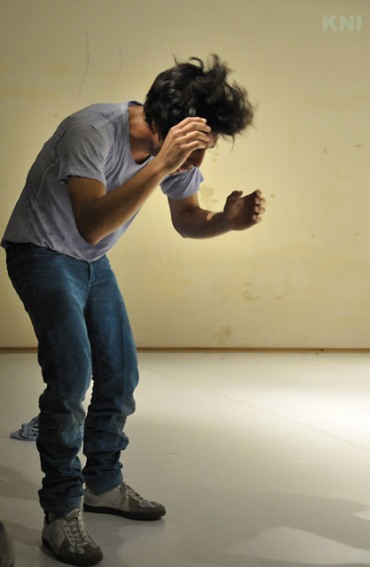
Rodrigo’s performance titled Mining is the simplest piece I have seen so far (though I’m young and have not seen so many contemporary performances as I would have liked to). It is basically made up of two parts. In the first part, the performer stages a seemingly neverending  scene of agony; he is writhing on the ground, breathing heavily, continuously wailing, suffering, as if his lungs and his body were thrown into a fit of convulsions. Giving out this hair-raising, nerve-racking sound of calvary, he is dragging himself along the the floor, at an excruciatingly slow pace, to arrive at the front of the stage, to throw his affliction into the face of the audience. He manages to stand up, but his misery does not come to an end yet; he suffers on, towards the other side of the stage, gets down to the floor again, tries to crawl under the dance floor, he stands up again, he is throwing himself against the wall, like he wants to get out of the space of the performance, away from the attention. Then he stops (it might be good to know, that by now at least 30 minutes of the 50-minutes long performance have passed). The second part of the piece begins. He acts like nothing happened, goes to the side of the stage, takes his bottle of water, and drinks almost the whole bottle. Casually, as if he were not in the middle of something fixed, something pre-planned and rehearsed. Afterwards, he takes a wooden board, jewelled with straps, and puts it on like a pair of wings. He makes some movements in this reborn form of a wooden dragonfly, then takes off this wing-like board and starts chopping it into two with an axe. 


And how did this extremely unusual piece affect me and other members of the audience? In the first 20 minutes, I was appalled, horrified, petrified, trying to grasp the meaning behind this piece, looking around, checking the reaction of the audience, only to see eyes just as surprised as mine were. How on earth can this be considered art?
Then my thoughts began to race. Instead of focusing on the performance taking place in front of me, my attention turned inwards, I started to analyse my own feelings and what I saw on the faces of the other viewers. The sound of the suffering artist became background noise for me (and it became routine for the artist). How sick is that? And still, how ordinary, how everyday, how typical of an average citizen, going past another member of society writhing in pain on the streets, just because (s)he is an outsider. Instantly, I became aware of my own ignorance, of my own hypocrisy, of me being able to contemplate about deeper meanings only because I stopped paying attention to all the hurt the artist was expressing, aware of my being just a member of the audience, aware of the borders of the stage, of the rules of a set piece, of the paradox that in this piece, it was not the artist who seemed to be constrained by a rigid script, but the audience; it was me who seemed to follow the screen-play of not looking away, of not leaving my seat, of not ignoring what the situation expected from me. 


So, basically, for me, this piece was centred around awareness:
-         Around audience-awareness: if this was happening in the outside world, I would call help, or – much as it hurts to admit the ugly truth – I would turn my eyes away, but in this case I’m aware that I’m supposed to focus on the performance and that the artist is allegedly faking his misery; thereby, the sense of being an observer is very intense;
-         Around performance-awareness: this is just a piece of art, all make-believe, so I can analyse it; being sophisticated, creating art allows me to depict social problems, but does it really solve anything? Is it not sanctimonious? Furthermore, the performance made me wonder how demanding it is to „fake” this suffering, and how demanding it is to experience it? To see it? To see it without intervening? Finally, since this was only make-believe, I didn’t think about the performer as sufferer, but as canvas, as symbol – not an actual human with feelings, but of course this might be only a sign of my own short-sightedness;
-         Around stage-awareness: when the performer tried to hide below the carpet covering the stage, I was shocked, it somehow seemed utterly unexpectable and surreal for me. But why? Had I always considered the dance carpet to be sacred, to be untouchable, like the actual ground of the performance, the border of art dimension, a layer below which there was supposed to be nothing? Well, now, the artist reminded me that it is only a regular carpet, and during suffering anything can happen, the sufferer/observed must not abide by the rules of art fabricated by humankind. But this was just the beginning. A bit later, after the performer stopped his route of calvary, we heard a phone ringing. First I thought someone from the audience forgot to silence his/her phone. Then I was appalled to see that the ringing phone was in the pocket of the artist’s jacket, the one that he previously took off during his suffering. The phone was in the performer’s “costume”. Hilarious.
-         About body-awareness: because, after the performer’s agony came to an end, he took a bottle of water and drank its whole content. Seems logical, doesn’t it? After all that demanding physical activity and sweating, it is completely understandable that the lost water needs to be replaced. I should not have been so surprised. The body has its needs, and it also has its socially set habits, like pulling one’s trousers up when one is conscious. This body-awareness can also be connected the wooden tablet the artist put on. It was like a pair of wings, through them, the performer stretched his bodily space, he was in control of his appearance, as opposed to what was going on in the first section of the piece. Then, at the end, he chopped his pair of wings with an ax. Did he not need it anymore? Did this act represent him breaking his own body?


Besides these different types of awareness, the performance also made me think of the performer as an embodiment of the weak: the beggar, the blind (as in the first part he kept his eyes closed, because it is less confronting), the ill, and, perhaps, the inner sufferer inside each and every one of us, our inner weak person whom we all prefer to ignore, in order to move on and save our face. After the performance, Rodrigo said that he had wanted to be in the moment. His words made me ponder to what an extent pain connects us to the present, to reality, to materiality, and to what extent one can lose touch with his/herself, with the present, with his/her sense of time, if (s)he chooses to ignore the pain inside.
As a conclusion, let me say a few words about the title. Mining, that is, bringing something up from under the surface, hard toil in order to find some kind of treasure. Does this mean that we need to let our pain work on us, so that we can find some gold in our wretched bones? On the other hand, ‘mining’ also brings another word to my mind: ‘undermining’, destroying something from under the surface. I could go on writing about the connection between this concept and the last part of the performance, but that piece of gold needs some more time before it can be mined.


Photos were borrowed from Kővágó Nagy Imre's website: http://kni7.wordpress.com/

Sunday, October 7, 2012

Naoko Tanaka / Die Scheinwerferin – The shine thrower, a journey inside


Die Scheinwerferin is not a dance piece. Not even a theatre performance. The closest thing I can think of to pigeonhole it is the category of movies. The white curtains stretched out to function as movie screens, the small light bulb dissecting the scenery like a camera, and the artist, Naoko staying in the background (even though she is in front of the screen), guiding us through the landscape with her little “camera”, acting like a “camerawoman”, shooting the movie which is immediately projected on the curtains behind; it is as if I was watching a live cinematic show. The whole plot is a projection of the performer’s journey among all the odds and ends assigned to be the props: a doll representing the artist, lying on the table; crumpled, damaged film rolls; a small ladder; a wire fence; crooked cutlery.. A package tour into the subconsciousness of the performer, The shine thrower depicts an experimental game with light and shadow with an aim to discovering what cannot be lit with a single lightbulb.
The first thing the artist explores with her tool is the doll on the table. The situation suggests medical atmosphere; she examines herself like a patient, trying to decipher her body limb by limb. But she goes beyong medicine’s borders, she goes deeper and descends the ladder. As the projection leads us among the damaged remains of the artist’s psyche, we can hear the noises of the mind, ethereal and formidable, mixed with sounds of reality, such as a train horning, waves clashing, or a conversation becoming distant.
It is, for example, because of the sound of waves that I think of the movie Inception. In the movie, when the protagonist arrived at the deepest layer of his dreams, he founded himself at a beach. Going under, going deeper, he emerged to another surface, to another dimension of reality, breathing and existing in another world. The same thoughts came to my mind during the piece: is it really now that the artist is going under? Is it not possible that she was underwater before and comes to the surface now? What makes the world of the mind less real than the world of the medical table?
The sound effects of the performance were not the only things that inspired me to think further. The crooked forks and spoons, looming menacingly on the surface of the curtains, made me reconsider the power of my own mind; to what extent could our unconsciousness distort our sense of reality? Do these pieces of cutlery represent deformed self-perception? Emotions? Thoughts? Moral values?
The crumpled film rolls, invoking distant conversations, are like memories damaged by time, fading into oblivion, showing the tragedy of time ticking ruthlessly, leaving nothing behind but some torn, dusty mental movies.
The road signs leading to diverging places remind me of my own choices at the crossroads of my life. Did I make up my mind too hastily? Will I move away from the other road fast enough to forget the directions? To witness it becoming unreachable? Or, as I go further and further away, will I end up at the same destination, realizing that all roads lead to the same end?
Last but not least, towards the end, the small lightbulb gets almost stuck in the wall of a wirefence. Is there a point, I was wondering, beyond which one cannot go in their own mind? Beyond psychological limits? Or are these limits constructed by ourselves, are they traps of our own minds, should we be afraid of being captivated by our own psyche?
The technical solutions of the performance made me think about the piece from a methodological point of view. I realized that everything that we saw on the screen were the result of the movement of the artist, even though we paid more attention to the shadow-movie than herself. She was like an invisible painter, painting with light and shadow, guiding our attention, focus, and, what is more, manipulating our perception by deciding on the size, angle, object of the projected material. Everything is just a matter of point of view, even when we are only in the mind of one performer. Light breeds darkness, and submergence lets us breathe fresh air. There is not one set reality carved into our skull. 

Photo by KNI - http://kni7.wordpress.com/2012/09/21/l1dancefest-2012-09-20/

This piece of writing can also be found on the blog of l1dancefest: 

Cie József Trefeli / Jinx 103


Two dancers and one roll of barrier tape; that is all Jinx 103 needed to amaze me. The simplicity, the dynamics, the playfulness, which was somehow maintained with dead serious tools, the atmosphere; all of this contributed to the birth of an astonishing performance.

Photo by KNI - http://kni7.wordpress.com/2012/09/20/l1dancefest-2012-09-19/#
The piece started out with the two dancers, József Trefeli and Gábor Varga chanting a Hungarian nursery rhyme and using a roll of barrier tape to create evanescent, ephemeral sculptures. These postures are held out for no more than a couple of seconds and then followed by another one. The tape falls helplessly to the floor, having completed its artistic mission. It might be interesting to note, though, the pejorative meaning of this. Barrier tape is usually used to, for instance, keep ordinary citizens out of a dangerous territory, such as a crime scene, or some major construction site. And somehow this function of the prop is realized, too; after this series of tape-sculptures, the two performers create a circle on the stage, they mark their territory, shutting the audience out, excluding them from the playground which also happens to be a fighting arena, even if the duel taking place in the ring is a playful one, reminding one of a teasing display of power. 
The nursery rhyme itself is also a ghost of childhood, and just like the fact (at least for me) that the performers let this tape-tures fall on the floor without any regret, there is no compulsive clinging to the past; letting go is a matter of attitude, not a matter of fear.
The nursery rhyme goes as follows: “Egyedem-begyedem tengertánc, Hajdú sógor mit kívánsz? Nem kívánok egyebet, csak egy szelet kenyeret.” The second part of the rhyme is worth some emphasis: “I do not want anything else, just a slice of bread.” In Hungarian, if you break bread with somebody, it means that you are becoming friends. It suggests simplicity and a kind of ritual, just like the whole choreography. Furthermore, the word “sea-dance” in the first line also somehow reminds me of the belonging, the vibration shared by the performers, and the co-dependency appearing in the structure of movements.

Photo by KNI - http://kni7.wordpress.com/2012/09/20/l1dancefest-2012-09-19/#
The choreography was created in the spirit of the title; when two persons say something at the same time by accident, in English you say “Jinx” and in Hungarian you say “103”. The only difference is that in Jinx 103 these meeting points are intentional: one of the dancers starts a dance pattern and the other follows, so the dance movements include both identical and contrastive segments. The choreography abounds in traditional Hungarian folk dance steps, and a part of the music is also of Hungarian folk music. The energy of folk dance is perfect for this function of playfulness: it is loud from all the clappings, it is dynamic thanks to the kicks, and it requires undivided attention from the dancers to synchronise the movements. It suggests concordance and equality.
The battle appearing in this dancing ring is only a teasing one, as if the steps of one performer asked the other, “what will you do now? Will you follow me? Can you keep the tempo?” This joyful dual is supported by the dancers keeping almost continous eye contact with each other, the audience functions only as a group of witnesses for the scene of playful teasing. Using Hungarian heritage and joint meeting points, the performers create something that is serious and childish, ancient and modern, entertaining and thought-provoking at the same time.
I honestly hope it was not the first and last time I saw the performance.


Photo by KNI - http://kni7.wordpress.com/2012/09/20/l1dancefest-2012-09-19/#

You can also read this critique on the blog of l1dancefest: http://l1dancefestival.blogspot.hu/2012/10/written-thoughts-by-adrienn-pasztoy1st.html
See other photos of this and other performances of L1dancefest on the Kővágó Nagy Imre's website: http://kni7.wordpress.com

The full performance can be watched on Youtube, part 1: http://www.youtube.com/watch?v=pcB0ktUhdkQ


part 2: http://www.youtube.com/watch?v=n4xNKle1Udk


Enjoy! :)

Christine Borch / The body that comes

All of us have a body. Some of us are more aware of it, some less. Some are more conscious about the external factors influencing their bodily presence, some less. Some rebel, some fight – with, against, or inside their body, some do not. We could reason about which attitude is more profitable and rewarding, but to no avail – in the end we are all shackled by the same physical and socio-cultural pitfalls. None of us can deny the importance of our relationship to our bodies. We all have a body that comes. Or one that goes.

Or both, as Christine Borch’s The Body That Comes suggests: in this contemporary performance, the dancer experiments with her limits while wearing a heavy-looking, long, thick cord wrapped around her neck, hiding her face, making her breathe in a desperate and demanding way. Her movements, her posture, her airless lungs mirror how much exposed she is to the force of gravity: she is dragging her feet along the floor, hardly for a minute can she keep the vertical distance from the theatrical chasm of the floor, she can only walk slowly due to this weight, this chain of oppression. She places her body weight on her hips, making this dance of helplessness somehow feminine, sensual, inviting (which tiny aspect could be extended into its own socio-cultural study).
But what is this cord wound up around the performer’s neck? For the very simple fact that I am into literature and tend to consider myself a writer at times, I usually interpret dance pieces according to the contextuality, the hidden meanings, the metaphors they convey for me. Thereby, my associations might not have much to do with the artist’s original intentions, with what the dancer was displaying in her dance. Should my shamelessly diverging conclusion be of disgracing value to the very existence of contemporary dance – I’m sorry. My body (and mind) simply come in another way. They must be going backwards.
So the questions, the possible meanings I thought of regarding the issue of this cord-cage are the following: does it represent illusions? Self-perfeption? Misperceptions? Bodily misfunctions? Errors? Baggage? The body itself? Another body? The gap between two bodies, may they belong to the same owner or different ones?
After the performer gets rid of this extra weight, this all-consuming jewellery, she is trying to adjust to the new circumstances; like a newborn who has just left the security of the mother womb, she breathes harder, she stumbles, she strives to stand up. This dance of inconvertibility lets the audience see the beauty of body mechanism: the desperately working muscles, the dancing skin, the sweat shining from the inner fight (why the author is so attracted to this aspect of dance might be a subject of a completely different kind of piece of writing).
Despite the struggle to adapt to the new circumstances, the honesty of pulling herself up by her hair to show her face, the newly won freedom from the cord-cage, the dancer puts this extra piece of cloth back on her, as if this dragging force had grown onto her existence, as if she felt too naked without it. Can she not function without this? Is she a prisoner of pleasure-pain principle? Has she got used to this suffering to such an extent that she does not know how to live without it?


But my own Freudian mental twinge made me misread reality.
Of course I may have completely misinterpreted the ending. The most likely scenario is that the dancer herself indeed has two bodies, and the piece shows the transition between those two. The new one is stronger, it reacts to the heavy snake-cord in a different way. It is less destructible, less vulnerable, subjected to its environment to a lesser extent. It can’t be pushed down by outside forces, by mere objects of misconceptions. It is completely in control.

You can also read this critique of mine on the blog of L1dancefest: